X-Men v1 #94-100.
Issue number 94 of X-Men, cover dated August 1975, was big; it was the opening volley of Chris Claremont's run on the title, which would go on to last a whopping 16 years and close to 200 issues. Len Wein, the writer of Giant Size X-Men 1, plotted the first two issues, and Dave Cockrum remained on board doing the art. Bill Mantlo was credited as a co-plotter for #96.
Another interesting point of note: between issues 94, which was edited by Wein, and 101, when Archie Goodwin took over, the book's editor was none other than Marv Wolfman. Wolfman later went on to greatness in the early 80s with, among other things, DC's New Teen Titans, which was very much a spiritual compatriot of Claremont's X-Men. Also, his name is really cool.
The relaunched book was bimonthly to begin with, all the way until #112.
The late seventies were a weird and wondrous time for X-Men fans. Most everything they knew was gone, and the revamped version they were stuck with was surprisingly good. The title stayed under the radar for a while, but unexpectedly, it kept getting better and better. In time, it became a true leader of the industry. There is some debate nowadays about how well Claremont's writing has aged. Personally, I think this period of his creative career, the first ten or so years of the X-Men, was unambiguously fantastic and remains a high water mark for superhero comics to this day. Plenty of people, however, are turned off by his wordy style and certain idiosyncrasies which we'll discuss at length over time.
Showing posts with label marvel girl. Show all posts
Showing posts with label marvel girl. Show all posts
Wednesday, 21 July 2010

Tuesday, 8 June 2010
Giant Size X-Men 1.
Giant-Size X-Men #1.
The early seventies were an important time for comics. While the X-Men were putting out reprints, the rest of the industry was changing rapidly. Stan Lee published a story about drugs in Amazing Spider-Man that proved to be the first nail in the coffin of the Comics Code Authority. A while later, Peter Parker's girlfriend Gwen Stacy took a a swan dive off the George Washington Bridge and died, leaving an indelible mark on the character's history and setting a dangerous precedent for future storytellers. Jack Kirby's creative differences with Marvel widened to the point where he decided to leave the company and start working for DC – and DC itself was finally catching up and starting to get good. The Silver Age ended and gave way to the Bronze Age.
Even the X-Men, despite their lack of an ongoing title, weren't forgotten. The team was still active, after all. Their untold adventures during the five year gap would later be covered in X-Men: The Hidden Years, a spin-off that started in 1999 and ran for 22 issues. Maybe I'll cover it someday. Some of the characters also drifted through other books at the time, and a few of the resulting stories are worth noting for posterity.
From the ashes of the past, there grow the fires of the future!
The early seventies were an important time for comics. While the X-Men were putting out reprints, the rest of the industry was changing rapidly. Stan Lee published a story about drugs in Amazing Spider-Man that proved to be the first nail in the coffin of the Comics Code Authority. A while later, Peter Parker's girlfriend Gwen Stacy took a a swan dive off the George Washington Bridge and died, leaving an indelible mark on the character's history and setting a dangerous precedent for future storytellers. Jack Kirby's creative differences with Marvel widened to the point where he decided to leave the company and start working for DC – and DC itself was finally catching up and starting to get good. The Silver Age ended and gave way to the Bronze Age.
Even the X-Men, despite their lack of an ongoing title, weren't forgotten. The team was still active, after all. Their untold adventures during the five year gap would later be covered in X-Men: The Hidden Years, a spin-off that started in 1999 and ran for 22 issues. Maybe I'll cover it someday. Some of the characters also drifted through other books at the time, and a few of the resulting stories are worth noting for posterity.
Saturday, 15 May 2010
Uncanny X-Men - Roy Thomas II.
X-Men v1 #55-66.
+063-00f.jpg)
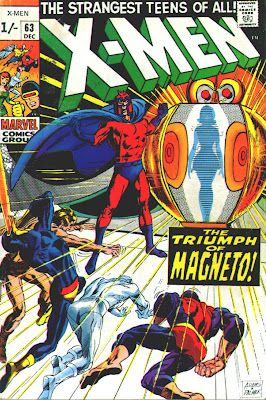
Roy Thomas returned to the X-Men for one final stretch of issues, starting with 55 (1969) and ending with 66 (1970). The only exception was the penultimate issue, 65, which was filled in by Dennis O'Neil. This was before he became famous, of course.
As for the art, issue 55 was drawn by good old Don Heck and Werner Roth, and issues 64 and 66 were done by, respectively, Don Heck alone and Sal Buscema, but most of the work, 56-63 and 65, was by the legendary Neal Adams. Adams was pretty much one of the best artists in the industry during the Bronze Age. Just a few years after his stint on X-Men, he and Dennis O'Neil did some very important work at DC which did a great deal to help them catch up to Marvel after the revolution of the sixties. This included redefining Batman, essentially making him the character he is today. Adams has also been one of the foremost advocates of creators' rights in the comics industry.
By the way, Stan Lee still received first billing as editor.
And they fought happily ever after....??
+063-00f.jpg)
Roy Thomas returned to the X-Men for one final stretch of issues, starting with 55 (1969) and ending with 66 (1970). The only exception was the penultimate issue, 65, which was filled in by Dennis O'Neil. This was before he became famous, of course.
As for the art, issue 55 was drawn by good old Don Heck and Werner Roth, and issues 64 and 66 were done by, respectively, Don Heck alone and Sal Buscema, but most of the work, 56-63 and 65, was by the legendary Neal Adams. Adams was pretty much one of the best artists in the industry during the Bronze Age. Just a few years after his stint on X-Men, he and Dennis O'Neil did some very important work at DC which did a great deal to help them catch up to Marvel after the revolution of the sixties. This included redefining Batman, essentially making him the character he is today. Adams has also been one of the foremost advocates of creators' rights in the comics industry.
By the way, Stan Lee still received first billing as editor.
Monday, 12 April 2010
Uncanny X-Men - Gary Friedrich, Arnold Drake.
X-Men v1 #44-54.
Roy Thomas left the X-Men in 1968. He'd be back in less than a year.
It's safe to say that his immediate successor, Gary Friedrich, was probably only a fill-in. Thomas plotted the first arc, which was concluded in a crossover with his own title, Avengers. Friedrich only wrote one of his four issues independently. #47 was co-written with Arnold Drake, who then took over for the remaining six issues until Thomas's return. Stan Lee was still credited first.
The art team for the eleven issues was more consistent. Issues 44-49, and 52, were all laid out by Don Heck and penciled by Werner Roth. 50-51 were done by the famous Jim Steranko, 53 by Barry Smith (who would later, as Barry Windsor-Smith, do some unforgettable work on Thomas's Conan the Barbarian title I mentioned last time) and 54 by Don Heck by his lonesome. Iceman's and Beast's respective origin arcs in the back-ups of issues 43-46 and 51-53 were drawn by George Tuska and Werner Roth respectively.
As of this moment... the X-Men no longer exist as a team!
Roy Thomas left the X-Men in 1968. He'd be back in less than a year.
It's safe to say that his immediate successor, Gary Friedrich, was probably only a fill-in. Thomas plotted the first arc, which was concluded in a crossover with his own title, Avengers. Friedrich only wrote one of his four issues independently. #47 was co-written with Arnold Drake, who then took over for the remaining six issues until Thomas's return. Stan Lee was still credited first.
The art team for the eleven issues was more consistent. Issues 44-49, and 52, were all laid out by Don Heck and penciled by Werner Roth. 50-51 were done by the famous Jim Steranko, 53 by Barry Smith (who would later, as Barry Windsor-Smith, do some unforgettable work on Thomas's Conan the Barbarian title I mentioned last time) and 54 by Don Heck by his lonesome. Iceman's and Beast's respective origin arcs in the back-ups of issues 43-46 and 51-53 were drawn by George Tuska and Werner Roth respectively.
Tuesday, 30 March 2010
Uncanny X-Men - Roy Thomas I.
X-Men v1 #20-43.
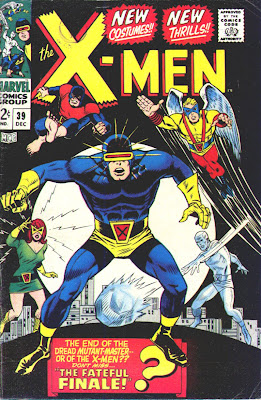
Roy Thomas's first stint on X-Men lasted from 1966 to 1968, covering issues #20-43. He was accompanied along the way by six different artists, the foremost among them being Werner Roth, who drew issues 20-29, 31-33 and 35, and who dropped the pseudonym “Jay Gavin” after #22. The other pencillers were Jack Sparling (30), Dan Adkins (34) and Ross Andru (36-42). Don Heck took over for five issues (38-42), but relinquished the final one (43) to fill-in George Tuska. Roth also pencilled the five-issue “Origins of the X-Men” back-up storyline from #38-42.

Roy Thomas's first stint on X-Men lasted from 1966 to 1968, covering issues #20-43. He was accompanied along the way by six different artists, the foremost among them being Werner Roth, who drew issues 20-29, 31-33 and 35, and who dropped the pseudonym “Jay Gavin” after #22. The other pencillers were Jack Sparling (30), Dan Adkins (34) and Ross Andru (36-42). Don Heck took over for five issues (38-42), but relinquished the final one (43) to fill-in George Tuska. Roth also pencilled the five-issue “Origins of the X-Men” back-up storyline from #38-42.
Sunday, 21 February 2010
Uncanny X-Men - Stan Lee.
X-Men v1 #1-19.
"Don't miss this fabulous 1st issue!"
"In the sensational Fantastic Four style!"
"The strangest super-heroes of all!"
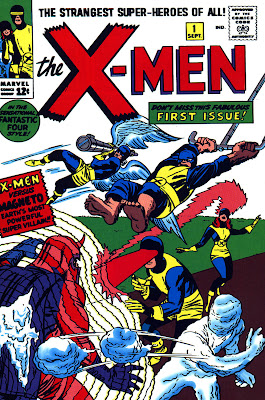
X-Men #1, by Stan Lee and Jack Kirby, was cover-dated September 1963. The book started off on a bimonthly schedule. Lee would stay on writing duties for nineteen issues, the last of which was cover-dated April 1966. Kirby penciled only eleven of them, and did the layouts for several issues as well before disappearing completely with #17. Seven of the eight remaining issues were drawn by Jay Gavin (Werner Roth). The art was competent throughout, never outstanding. I won't have much more to say about it.
"Don't miss this fabulous 1st issue!"
"In the sensational Fantastic Four style!"
"The strangest super-heroes of all!"

X-Men #1, by Stan Lee and Jack Kirby, was cover-dated September 1963. The book started off on a bimonthly schedule. Lee would stay on writing duties for nineteen issues, the last of which was cover-dated April 1966. Kirby penciled only eleven of them, and did the layouts for several issues as well before disappearing completely with #17. Seven of the eight remaining issues were drawn by Jay Gavin (Werner Roth). The art was competent throughout, never outstanding. I won't have much more to say about it.
Subscribe to:
Posts (Atom)
