X-Men v1 #125-128.
Mutant X is one of those stories. You know what I mean – a classic.
When the time came to reinterpret the X-Men mythos twenty years later, one of the first story arcs in Ultimate X-Men was a retelling of Mutant X. In fact, it arguably got one of the most faithful reinterpretations in the new series. Aside from the fact that it's a damn good story, the general affection for it is probably due to two facts: the figure of Proteus (whom I'll discuss more at the end) and the concision of the arc. Despite the laborious, long-reaching setup, the story itself is contained neatly in just four issues. This distinguished it among Claremont's web of plots, and made it stand out more than, say, the Phoenix Saga, which was composed of a lot of separate elements and was told over a longer period of time.
Showing posts with label colossus. Show all posts
Showing posts with label colossus. Show all posts
Friday, 31 December 2010

Tuesday, 30 November 2010
Uncanny X-Men - Annual 1979.
X-Men v1 Annual #03.
By 1979, the X-Men had gotten popular enough to earn an annual. Technically, this was their third one (as acknowledged by the numbering), but the first two were reprints thrown together from regularly published issues during the dark days of 1970-1975, so they didn't really matter.
By 1979, the X-Men had gotten popular enough to earn an annual. Technically, this was their third one (as acknowledged by the numbering), but the first two were reprints thrown together from regularly published issues during the dark days of 1970-1975, so they didn't really matter.
Uncanny X-Men - Chris Claremont V.
X-Men v1 #122-124.
It's early 1979 and big things are afoot. The most significant X-Men storyline of all is just around the corner, less than a year away, and another plotline has been teased for years now. But the X-Men have just returned from a madcap globe-trotting adventure, they're separated from some of their own and still believe the others to be dead. At this point, there's really no status quo to speak of. Moving right on to the next epic storyline would have been foolish, and if you think Claremont (and co-plotter Byrne) would have made that mistake, you haven't been paying attention.
The intervening three issues shift focus a bit, first with another breather issue and then a fairly fluffy supervillain attack with little drama (though that might not have been intentional).
It's early 1979 and big things are afoot. The most significant X-Men storyline of all is just around the corner, less than a year away, and another plotline has been teased for years now. But the X-Men have just returned from a madcap globe-trotting adventure, they're separated from some of their own and still believe the others to be dead. At this point, there's really no status quo to speak of. Moving right on to the next epic storyline would have been foolish, and if you think Claremont (and co-plotter Byrne) would have made that mistake, you haven't been paying attention.
The intervening three issues shift focus a bit, first with another breather issue and then a fairly fluffy supervillain attack with little drama (though that might not have been intentional).
Sunday, 31 October 2010
Uncanny X-Men - Chris Claremont IV.
X-Men v1 #117-121.
While Wolverine was already starting to drift into focus in the Savage Land story, he became much more prominent in the final chapters of the X-Men's tour around the world. We started finding out more and more about him – including, at long last, his real name. (Which wasn't actually his real name at all, of course, but let's not split hairs.) Buuuut this information was presented to us in tantalizing bits and pieces. In contrast, Storm's we learned of Storm's entire history in the span of a couple of pages. Wolverine is an enigma, a man whose past is shrouded in mystery... even to himself, as it turned out. This would become crucial to his character. Claremont had a plan for his backstory, but it ultimately didn't work out, so for the longest time, he literally didn't have a past.
While Wolverine was already starting to drift into focus in the Savage Land story, he became much more prominent in the final chapters of the X-Men's tour around the world. We started finding out more and more about him – including, at long last, his real name. (Which wasn't actually his real name at all, of course, but let's not split hairs.) Buuuut this information was presented to us in tantalizing bits and pieces. In contrast, Storm's we learned of Storm's entire history in the span of a couple of pages. Wolverine is an enigma, a man whose past is shrouded in mystery... even to himself, as it turned out. This would become crucial to his character. Claremont had a plan for his backstory, but it ultimately didn't work out, so for the longest time, he literally didn't have a past.
Sunday, 26 September 2010
Uncanny X-Men - Chris Claremont III.
X-Men v1 #111-116.
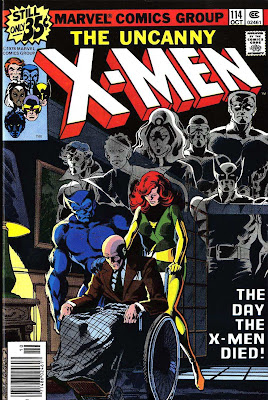
At this point, a few issues past the end of the Phoenix Saga, it's safe to say that the transition period is over. Claremont has settled. Even better, the new faces on the team have proven themselves as worthy by being so damn interesting. Reader reaction was very favorable, though the title wasn't noticed by a wider audience right away. I take the fact that it took the book three years to switch from bimonthly to monthly to be evidence of this. (#112 was the first issue in the new schedule.) Another important thing to note: #114 was the first issue where the book's title gained the "Uncanny" header. It's standard hyperbolic superhero aggrandizement, but it took a while until it actually became part of the title.

At this point, a few issues past the end of the Phoenix Saga, it's safe to say that the transition period is over. Claremont has settled. Even better, the new faces on the team have proven themselves as worthy by being so damn interesting. Reader reaction was very favorable, though the title wasn't noticed by a wider audience right away. I take the fact that it took the book three years to switch from bimonthly to monthly to be evidence of this. (#112 was the first issue in the new schedule.) Another important thing to note: #114 was the first issue where the book's title gained the "Uncanny" header. It's standard hyperbolic superhero aggrandizement, but it took a while until it actually became part of the title.
Thursday, 26 August 2010
Uncanny X-Men - Chris Claremont II.
X-Men v1 #101-110.

Issue #101 marked the beginning of the Phoenix Saga, the conclusion of the Eric the Red subplot and culmination of a year's worth of stories from Claremont. And yet, the Phoenix Saga was also a stepping stone for bigger and better things. It's a story where the X-Men save the entire universe, an epic, and yet it was handily eclipsed by the Dark Phoenix Saga. It brought back a few classic X-Men villains to face off against the new team, but it also introduced a veritable host of new supporting characters.
This period also marks a transition for the art team. Penciller (and co-creator) Dave Cockrum decided to leave the book, though he returned for a considerable stretch of issues a few years down the line. He handed the reins over to Jack Byrne starting with #108. He unfortunately left right during the climax of the storyline, but Byrne was similar enough to him stylistically that the change isn't exactly jarring, or perhaps even very noticeable (at least to someone whose eye for art is as horrible as mine).
#106 was filled in by Bob Brown (and, incidentally, plotted by Bill Mantlo, due to complicated circumstances that I'll explain later) and #110 by Tony DeZuga, with assists provided by Cockrum.

Issue #101 marked the beginning of the Phoenix Saga, the conclusion of the Eric the Red subplot and culmination of a year's worth of stories from Claremont. And yet, the Phoenix Saga was also a stepping stone for bigger and better things. It's a story where the X-Men save the entire universe, an epic, and yet it was handily eclipsed by the Dark Phoenix Saga. It brought back a few classic X-Men villains to face off against the new team, but it also introduced a veritable host of new supporting characters.
This period also marks a transition for the art team. Penciller (and co-creator) Dave Cockrum decided to leave the book, though he returned for a considerable stretch of issues a few years down the line. He handed the reins over to Jack Byrne starting with #108. He unfortunately left right during the climax of the storyline, but Byrne was similar enough to him stylistically that the change isn't exactly jarring, or perhaps even very noticeable (at least to someone whose eye for art is as horrible as mine).
#106 was filled in by Bob Brown (and, incidentally, plotted by Bill Mantlo, due to complicated circumstances that I'll explain later) and #110 by Tony DeZuga, with assists provided by Cockrum.
Wednesday, 21 July 2010
Uncanny X-Men - Chris Claremont I.
X-Men v1 #94-100.
Issue number 94 of X-Men, cover dated August 1975, was big; it was the opening volley of Chris Claremont's run on the title, which would go on to last a whopping 16 years and close to 200 issues. Len Wein, the writer of Giant Size X-Men 1, plotted the first two issues, and Dave Cockrum remained on board doing the art. Bill Mantlo was credited as a co-plotter for #96.
Another interesting point of note: between issues 94, which was edited by Wein, and 101, when Archie Goodwin took over, the book's editor was none other than Marv Wolfman. Wolfman later went on to greatness in the early 80s with, among other things, DC's New Teen Titans, which was very much a spiritual compatriot of Claremont's X-Men. Also, his name is really cool.
The relaunched book was bimonthly to begin with, all the way until #112.
The late seventies were a weird and wondrous time for X-Men fans. Most everything they knew was gone, and the revamped version they were stuck with was surprisingly good. The title stayed under the radar for a while, but unexpectedly, it kept getting better and better. In time, it became a true leader of the industry. There is some debate nowadays about how well Claremont's writing has aged. Personally, I think this period of his creative career, the first ten or so years of the X-Men, was unambiguously fantastic and remains a high water mark for superhero comics to this day. Plenty of people, however, are turned off by his wordy style and certain idiosyncrasies which we'll discuss at length over time.
Issue number 94 of X-Men, cover dated August 1975, was big; it was the opening volley of Chris Claremont's run on the title, which would go on to last a whopping 16 years and close to 200 issues. Len Wein, the writer of Giant Size X-Men 1, plotted the first two issues, and Dave Cockrum remained on board doing the art. Bill Mantlo was credited as a co-plotter for #96.
Another interesting point of note: between issues 94, which was edited by Wein, and 101, when Archie Goodwin took over, the book's editor was none other than Marv Wolfman. Wolfman later went on to greatness in the early 80s with, among other things, DC's New Teen Titans, which was very much a spiritual compatriot of Claremont's X-Men. Also, his name is really cool.
The relaunched book was bimonthly to begin with, all the way until #112.
The late seventies were a weird and wondrous time for X-Men fans. Most everything they knew was gone, and the revamped version they were stuck with was surprisingly good. The title stayed under the radar for a while, but unexpectedly, it kept getting better and better. In time, it became a true leader of the industry. There is some debate nowadays about how well Claremont's writing has aged. Personally, I think this period of his creative career, the first ten or so years of the X-Men, was unambiguously fantastic and remains a high water mark for superhero comics to this day. Plenty of people, however, are turned off by his wordy style and certain idiosyncrasies which we'll discuss at length over time.
Tuesday, 8 June 2010
Giant Size X-Men 1.
Giant-Size X-Men #1.
The early seventies were an important time for comics. While the X-Men were putting out reprints, the rest of the industry was changing rapidly. Stan Lee published a story about drugs in Amazing Spider-Man that proved to be the first nail in the coffin of the Comics Code Authority. A while later, Peter Parker's girlfriend Gwen Stacy took a a swan dive off the George Washington Bridge and died, leaving an indelible mark on the character's history and setting a dangerous precedent for future storytellers. Jack Kirby's creative differences with Marvel widened to the point where he decided to leave the company and start working for DC – and DC itself was finally catching up and starting to get good. The Silver Age ended and gave way to the Bronze Age.
Even the X-Men, despite their lack of an ongoing title, weren't forgotten. The team was still active, after all. Their untold adventures during the five year gap would later be covered in X-Men: The Hidden Years, a spin-off that started in 1999 and ran for 22 issues. Maybe I'll cover it someday. Some of the characters also drifted through other books at the time, and a few of the resulting stories are worth noting for posterity.
From the ashes of the past, there grow the fires of the future!
The early seventies were an important time for comics. While the X-Men were putting out reprints, the rest of the industry was changing rapidly. Stan Lee published a story about drugs in Amazing Spider-Man that proved to be the first nail in the coffin of the Comics Code Authority. A while later, Peter Parker's girlfriend Gwen Stacy took a a swan dive off the George Washington Bridge and died, leaving an indelible mark on the character's history and setting a dangerous precedent for future storytellers. Jack Kirby's creative differences with Marvel widened to the point where he decided to leave the company and start working for DC – and DC itself was finally catching up and starting to get good. The Silver Age ended and gave way to the Bronze Age.
Even the X-Men, despite their lack of an ongoing title, weren't forgotten. The team was still active, after all. Their untold adventures during the five year gap would later be covered in X-Men: The Hidden Years, a spin-off that started in 1999 and ran for 22 issues. Maybe I'll cover it someday. Some of the characters also drifted through other books at the time, and a few of the resulting stories are worth noting for posterity.
Subscribe to:
Posts (Atom)
